 Image 1 of 1
Yves Saint Laurent’s fascination with African art—particularly the symbolic power and sculptural elegance of the Senufo bird—played a pivotal role in shaping the collector’s eye of Louys. Encountering YSL’s celebrated Senufo bird sculpture, Louys was struck not only by its commanding presence but also by its cultural resonance and refined aesthetic balance. Inspired by the way Saint Laurent elevated such an object within a contemporary interior, Louys became determined to source an authentic Senufo bird sculpture of comparable size and value. His pursuit was guided by a desire to capture that same dialogue between tradition and modernity, ultimately leading him to acquire a piece that echoed the stature, craftsmanship, and spiritual symbolism that had so captivated him in YSL’s collection.
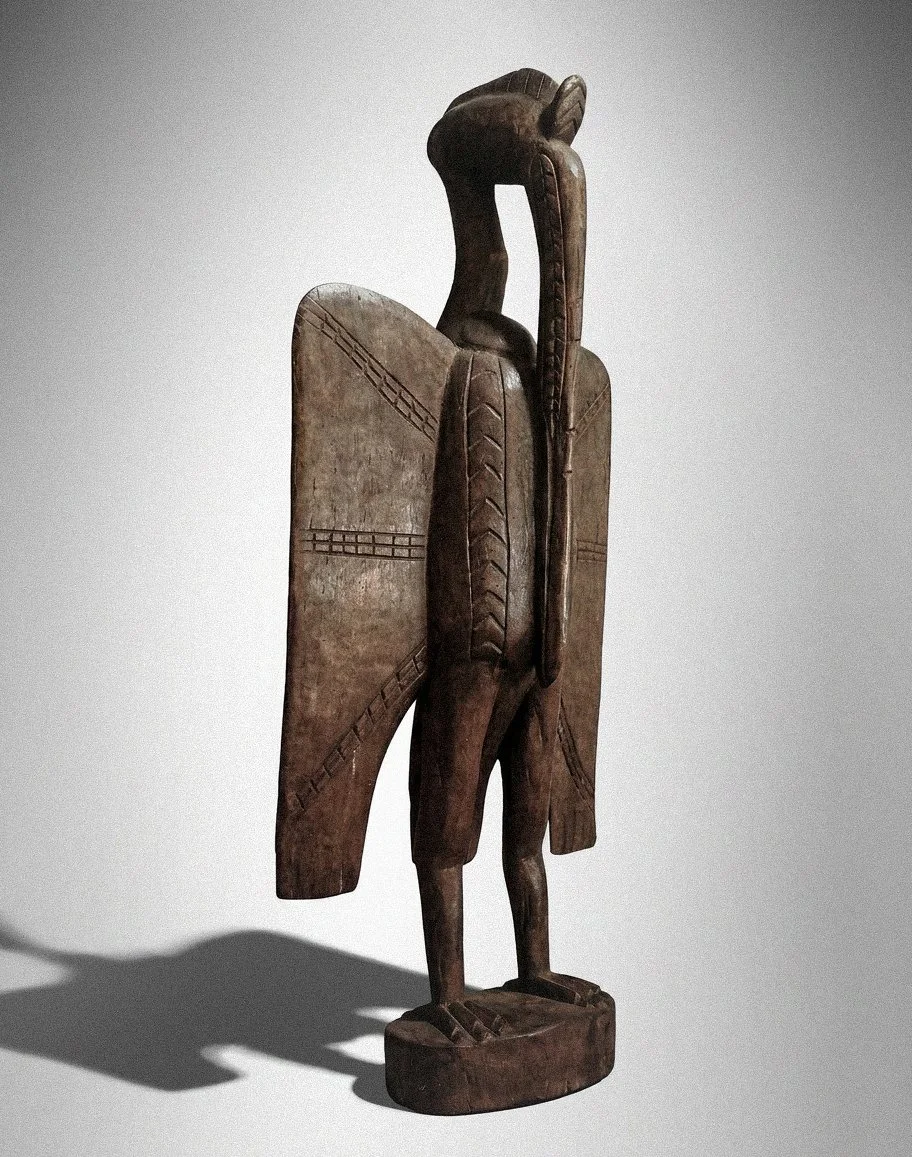
The Senufo hornbill sculpture, often called porpianong, is one of the most important ritual artworks of the Senufo people of West Africa (primarily in present-day Côte d’Ivoire, Mali, and Burkina Faso). Carved from wood, these figures are closely tied to the Poro society, a male initiation association responsible for transmitting spiritual knowledge, social values, and history across generations. Historically, hornbill sculptures have been used for centuries in initiation ceremonies, where they could be carried or displayed as powerful teaching objects that connect initiates to ancestral wisdom and cosmological beliefs. The hornbill itself is considered a primordial creature—sometimes viewed as one of the first beings created—and symbolizes fertility, continuity, and the balance of male and female forces, often expressed through its distinctive form with a curved beak touching a swollen belly. Beyond ritual use, these sculptures embody the authority of elders and the moral structure of Senufo society, reinforcing ideals about community, lineage, and the relationship between the human and spiritual worlds. Over time, many of these once-sacred objects have entered museums and the global art market, where they are appreciated both for their symbolic meaning and their striking abstract aesthetic.
Measurements: Height: 28 in, Length: 12 in
Weight: 2.6 lb
Material: Natural Wood
Disclaimer — As many of our items are vintage or made by hand from natural wood, natural variations, markings, and signs of age are part of their unique character.
Yves Saint Laurent’s fascination with African art—particularly the symbolic power and sculptural elegance of the Senufo bird—played a pivotal role in shaping the collector’s eye of Louys. Encountering YSL’s celebrated Senufo bird sculpture, Louys was struck not only by its commanding presence but also by its cultural resonance and refined aesthetic balance. Inspired by the way Saint Laurent elevated such an object within a contemporary interior, Louys became determined to source an authentic Senufo bird sculpture of comparable size and value. His pursuit was guided by a desire to capture that same dialogue between tradition and modernity, ultimately leading him to acquire a piece that echoed the stature, craftsmanship, and spiritual symbolism that had so captivated him in YSL’s collection.
The Senufo hornbill sculpture, often called porpianong, is one of the most important ritual artworks of the Senufo people of West Africa (primarily in present-day Côte d’Ivoire, Mali, and Burkina Faso). Carved from wood, these figures are closely tied to the Poro society, a male initiation association responsible for transmitting spiritual knowledge, social values, and history across generations. Historically, hornbill sculptures have been used for centuries in initiation ceremonies, where they could be carried or displayed as powerful teaching objects that connect initiates to ancestral wisdom and cosmological beliefs. The hornbill itself is considered a primordial creature—sometimes viewed as one of the first beings created—and symbolizes fertility, continuity, and the balance of male and female forces, often expressed through its distinctive form with a curved beak touching a swollen belly. Beyond ritual use, these sculptures embody the authority of elders and the moral structure of Senufo society, reinforcing ideals about community, lineage, and the relationship between the human and spiritual worlds. Over time, many of these once-sacred objects have entered museums and the global art market, where they are appreciated both for their symbolic meaning and their striking abstract aesthetic.
Measurements: Height: 28 in, Length: 12 in
Weight: 2.6 lb
Material: Natural Wood
Disclaimer — As many of our items are vintage or made by hand from natural wood, natural variations, markings, and signs of age are part of their unique character.